Search This Blog

Showing posts with label Mobile. Show all posts

Saturday, June 18, 2011

Palm TX Handheld

Product Description

Created for today's fast-paced mobile landscape, the sleekly lightweight Palm TX handheld keeps you connected to your most important data--from email to files stored on your office PC--while you're away from your desktop with built-in Wi-Fi and Bluetooth wireless connectivity. It also features a high-resolution 320 x 480-pixel screen (with portrait and landscape orientation modes), a fast Intel 312 MHz ARM-based processor, expansion slot for Secure Digital (SD), MultiMedia (MMC), and Secure Digital I/O (SDIO) cards. The 128 MB of non-volatile flash memory (of which approximately 100 MB is available for files and software) protects your documents and information, even if the device is not charged and the power runs down. And, of course, the Palm TX features Palm's suite of information management applications, the ability to edit Word- and Excel-compatible files, and synchronization with Microsoft Outlook (Windows only). Built-in Wi-Fi and Bluetooth Wireless Connectivity
Stay connected easily when you're on the go with the built-in Wi-Fi wireless connectivity (802.11b), which enables you to access email and browse the Web at hotspots such as at coffee shops and in airports, or in your office if you have a wireless LAN network. You can even retrieve documents from your main computer with the included WiFile LT software. The Palm TX also comes the following enhancements:
  • Added ability for the device to scan for available networks
  • Improved connection logic to automatically connect to available compatible networks
  • Three steps to easily set up a new network connection
  • A free 30-day subscription to all T-Mobile Wi-Fi hotspots
With built-in wireless Bluetooth connectivity (version 1.1), you can synchronize the Palm TX with a Bluetooth-enabled computer from across the room (within a range of 10 meters, or approximately 30 feet). But that's just the start. Using a compatible Bluetooth-enabled phone, you can send and receive e-mail and connect to the Web, send multimedia (MMS) or text (SMS) messages, and even automatically dial any number in your handheld's Contact's application. (You can also synchronize data the "old-fashioned" way via the USB connection at the base of the handheld.) For mobile professionals, the Palm TX provides all the conveniences of managing email on the road. With Wi-Fi access or Bluetooth technology, you can check corporate or campus email as well as personal accounts; download, read and edit a Word or Excel report on the fly; synchronize Outlook contacts, calendar, tasks and memos; and work with Microsoft Exchange ActiveSync, using VersaMail software, to synchronize email and calendar
Expansion Capabilities
The expansion card slot for MMC, SD and SDIO formats lets you insert a memory card from a digital camera and view photos on the large, color display; you can even can add transitions between photos and present them as a slideshow. The Palm TX handheld's compatibility with SD Cards up to 2GB lets road warriors carry a few favorite home videos and be entertained on long trips.
Support for Word, Excel, PowerPoint and PDF files
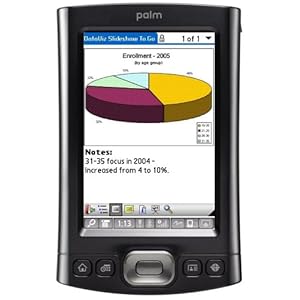
With the included DataViz Documents To Go software, you rehearse your PowerPoint presentation discreetly in an airport, make last-minute changes to a Word document, and check the numbers in an Excel spreadsheet and update them on the spot. The Palm TX comes with support for native Word, Excel, and PowerPoint files. And with the included Adobe Reader for Palm OS, you can download and view converted Acrobat files.
Multimedia
The Palm TX comes bundled with Pocket Tunes MP3 player for playing music files or Podcasts, which allows you to create and edit play lists, shuffle songs and navigate by album, artist or genre. The Palm TX also includes built-in software for viewing digital photos and video clips. And with MobiTV software (sold separately), you can view a wide range of television programs, including news, sports and entertainment, directly on the Palm TX handheld.
Operating System and Software
Veteran Palm OS handheld users will immediately notice the new Favorites view, which provides easy access to applications, files, and folders. The installed Palm OS 5.4 also introduces the Files application, which enables easy navigation among folders and files. It uses the intuitive and easy-to-learn Graffiti 2 writing software to input data into the handheld (as well as an on-screen keyboard). Windows users can synchronize their calendar, contacts, tasks, and notes with Microsoft Outlook. The Palm OS features the following organizer applications:
  • Contacts: Lets you store several addresses for each contact, and with new fields for more phone numbers, multiple e-mail addresses, instant messenger IDs, and Web sites.
  • Calendar: Use the new Agenda view to see upcoming calendar events, tasks due, and important e-mail, and color-code your events to provide an easy way to reference your calendar in the Agenda, Day, Week, and Month views. Take more notes, or synchronize more details from your desktop, in the larger Memos and Notes fields.
  • Tasks: Use tasks with alarms and repeating tasks to set reminders for important commients.
Compatibility
The Palm TX is compatible with PCs running Windows Windows 2000 (SP4) and XP (Outlook synchronization requires MS Outlook 2000, 2002, or 2003; sold separately), and with Macs running Mac OS 10.2.8 to 10.4.  

What's in the Box
Palm TX handheld, flip cover, USB sync cable, power adapter, 3-step setup poster, Graffiti 2 sticker, Software Install CD-ROM with Palm Desktop, Tutorial, Getting Started Guide, User Guide, and bonus software.

Review by Stephen Charme
I have been using a Palm m515 for the past several years and was waiting for the right moment to upgrade. I purchased the TX with some reservations because Palm has had quality issues, and I wanted to avoid the aggravation I initially had with my m515. I have owned my TX for about a month and have no complaints so far.

In reading my review and other reviews, keep in mind that each person buys this unit with different expectations and uses, and what matters to one person may be irrelevant to another. With that perspective in mind, let me go over the features that I like.

The TX has a nice feel and appearance;the stylus is nicely weighted and fits snugly in the slot. The color screen is vivid and beautiful to look at. I read literally dozens of e-books each year, so screen resolution and brightness are important to me. The TX excels. Even when the brightness is dimmed to the lowest setting, which I sometimes do when reading in bed at night, reading is very easy.

Wi-Fi access is effortless. I took it on vacation and had no trouble using the wireless network at the resort where I was staying. The same is true when I use it at home. I purchased the Handmark Pocket Express software, which comes as a trial version, which I find a very convenient way to keep up with the news, sports, stocks, weather etc. when traveling. Even in my own house I use it since it is often easier to reach for my Palm TX rather than my laptop or go to my desktop. I have also ordered a cable from SupplyNet to connect my TX to my cell phone(I don't have a bluetooth phone) when wireless is not available.

I own an ipod mini, and found that trying to use the TX as an mp3 player was not worth the bother compared to the ease of use with my ipod. There is a reason that Apple dominates the mp3 player field.

Downloading photos is easy, but they don't look as bright and sharp as I would have liked, though the quality is still acceptable.

As other users have pointed out, the power button is too recessed and can be a bit of a nuisance to use. I seldom bother with it anyhow and use a free program called Off-It to turn the TX off, and one of the buttons at the bottom to turn it on.

When I upgraded from my m515, I did run into some compatibility problems, but this is no different than buying a new computer(and the TX is indeed a computer) and trying to download programs that are several years old. For programs that did not wind up on the TX after I synced, I simply beamed them from my m515 to the TX; some worked and some did not. I also had to beam my contact database and datebook database because for some reason they did not hotsync. I strongly recommend a free program called FileZ that enables you to manage your files, and beam databases. If you are upgrading from an older handheld, make sure that you have it installed in case you run into a problem, as I did, during the hotsync process.

Graffiti 2 is a bit different than the original Graffiti, but not a big deal to learn. If this is your first Palm, Graffiti 2 is so much easier to learn.

The TX comes with VersaMail, which unfortunately does not retrieve Hotmail. But it does retrieve email from most major internet providers, so when I travel I just use one of my other accounts. You do need a bit of technical knowledge to configure your mail settings, but once that is done, sending and retrieving messages is effortless so long as you don't need to send or view attachments, which always has certain problems.

I strongly recommend purchasing an SD card and a well known program called BackupBuddy, which will enable you to schedule daily automatic backups to the SD card(the TX does not need to be left on to do this--my backups are at 4am each day). When I had my m515, more than once when I was on vacation and not able to hotsync, I had the unit crash and lose all the data, which I then restored from the backup on my SD card.

I use Datebook 5 instead of the built in calendar, and find that the version for the operating system on the TX has some nice extra features that I did not have when I used my m515.

For my purposes the TX is perfect, and so far has worked without any problems. You really have to decide what you are looking for in a handheld before making your purchase decision. That way you won't be disappointed.

Update January 1, 2009: After three years and a new motherboard, my Palm TX needed a new LCD display. Rather than spending any more money for repairs or buying a new unit, I instead decided to purchase an iTouch 16 GB second generation. I have written an extensive review showing how the iTouch can be used as a pda in place of a Palm TX.

Update November 1, 2009: I have had a great experience using my iPod Touch as a PDA in place of my Palm TX. Unless there are specific applications that you need (such as medical applications) and which exist only for the Palm TX, I would definitely NOT buy a Palm TX as a PDA, especially since the price has increased dramatically even though no improvements have been made to the OS. The iPod Touch is just a superior product in so many ways.

Update December 3, 2010: I am still using my same iPod Touch 2G as a pda and am very happy that my Palm TX days are long gone. As of this date my lengthy review of the iPod Touch and how to use it as a pda is under tab 30 of my reviews, though that number will change as I continue to write more reviews.

View original article and reviews here

Sunday, June 12, 2011

T Mobile Coverage | Lowell ZBA Delays Cell-antenna Bid


LOWELL — The city’s Zoning Board of Appeals final night behind statute on T-Mobile’s offer to put unit antennas on tip of the town H2O container at 78 Wedge St. and asked the firm to pay for an eccentric examination of its plan.

ZBA members told the telecommunications firm that they wish explanation from an unbiased source that there is truly a cellphone coverage hole in the area surrounding the H2O tank.

Some house members moreover mentioned they wish to find out if the draft site could assimilate similar antennas for two extra users, that is compulsory for cell-tower proposals beneath the city’s zoning ordinance.
Representatives for T-Mobile who were present final night mentioned they did not have the control to consent to profitable is to peer-review study, but would look for that skill and inform back to the ZBA at its next scheduled discussion on June 13. At that time, the parameters for what the counterpart examination would concentration on could be more evidently defined.

Andrew Thompson, a real-estate dilettante for T-Mobile, moreover emphasized the firm has no control on either the town decides to franchise extra space on top of the H2O container to other telecommunications companies.

The City Council voted Jan. 18 to franchise the space on the H2O container to T-Mobile for 5 years with the chapter that the firm pay the town $1,800 a month with a annual escalation of 3 percent.

In new weeks, Highlands residents have advance to the City Council and orderly

Three of the ZBA’s 5 choosing by casting votes members mentioned they had major questions about the Wedge Street offer and two indicated they would be hard-pressed to encouragement the plan.
ZBA associate Vesna Nuon mentioned he was anxious the draft place is in the heart of a residential neighborhood. He moreover mentioned he was disturbed that if T-Mobile’s request was granted, it’s expected other firm would advance back in months and inquire to co-locate unit antennas at the tip of the H2O tank.

“I regard you should look at other options,” Nuon mentioned to T-Mobile.
The communications firm countered that fixation antennas on an existing make up is sufficient reduction forward in a village than installing a new tower.

T-Mobile seems to need an extreme amount of unit towers in the city, mentioned ZBA associate Corey Belanger. He sharp out that the communications firm has a building roughly every 1 to 1.5 miles opposite Lowell.

The telecommunications firm has unit antennas at 1221 Westford St., 204 Liberty St., 106 Marginal St. and 900 Chelmsford St., amid other places in the Highlands. The firm is moreover conducting an eccentric counterpart examination for its offer to franchise home from the town at 363 Boston Road to erect a 150-foot unit tower.

“It is apropos a bit sufficient when you are inundating our neighborhoods with these towers,” Belanger said.
State Rep. Kevin Murphy, a Lowell Democrat who represents the Highlands, mentioned there have been no complaints of bad T-Mobile coverage in the area. He highlighted that he and a organisation of local residents tested T-Mobile gadgets in assorted tools of the village final week and had burly accepting signals on the phones and successfully finished calls.

Steven E. Grill, a counsel for T-Mobile, mentioned the tests Murphy conducted were anecdotal and the communications firm is focused on enhancing coverage for users inside their homes.
Marion Dodge, a ZBA swap not long ago allocated by City Manager Bernie Lynch, was the usually associate of the ZBA to voice encouragement is to proposal, mission the H2O container “a great site.”

View the original article here
Related Products

Saturday, June 11, 2011

Music Mobile | Can The IPad And IPhone Rescue The Cloud?

The hype on the cloud is just as loud as the hype on mobile computing. Both appear to be gold rush destinations for vendors seeking to capitalize on all the stuff that buyers allegedly can’t get enough of. But if you look at the numbers, you see that mobile is where the money is being made, while the entire cloud market pulls in about 1 or 2 percent of what mobile does.

It seems to me that the cloud needs to be rescued, and perhaps mobile la iPad, iPhone, and Android is the technology to do it.


The numbers overwhelmingly point to mobile’s bulging bank account

But first, let me detail the numbers. Cloud services brought in about $3 billion in 2010 from its three main components: infrastructure (IaaS), platform (PaaS), and software (SaaS) offerings. In IaaS, Amazon.com’s Amazon Web Services (AWS) made about $500 million in 2010, and Rackspace — the No. 2 IaaS provider — raked in about $100 million. SaaS did better: Salesforce.com pulled in $1.3 billion in 2010, with the other four major SaaS providers — NetSuite, RightNow, SuccessFactors, and Taleo — earning about $200 million each. Revenues for PaaS offerings — exemplified by Salesforce.com’s Force.com and Microsoft’s Azure — aren’t broken out but are widely believed to be minuscule.

I’m not counting sales of so-called private cloud technology, as that means pretty much anything in a data center, which covers most of what IT’s expenditures ($1.5 trillion on tech last year). Whether you think a private cloud is a real cloud or just marketing buzz for the same old server, storage, and network gear (using virtualization, of course!), it’s money that IT would be spending anyhow. Even if you decide that virtualization spend should be counted as cloud spend, that adds “only” about $5 billion to the cloud total, bringing it to $8 billion.

Now to some real money: Mobile technology brought in $173 billion in 2010 from its major sources: $62 billion in 3G data plans, $99 billion in smartphone sales ($29 billion to Apple, $20 billion to Nokia, $15 billion to Research in Motion, and $9 billion to Samsung), $10 billion in tablet sales (almost all iPads last year), and $2 billion in app sales ($1.7 billion to Apple alone). Note that I’m not including iTunes and similar music, book, and video sales via mobile devices, as they can be accessed on both PCs and mobile devices. If you’re curious, they added up to $8 billion, with $4.1 billion going to Apple and $3.3 billion going to Amazon.com, including for the Kindle hardware.

How the cloud can hitch itself to the mobile bandwagon
As these numbers show, when you look at the whole mobile market, the cloud appears downright sickly as a business. Maybe mobile can help. After all, what other computing platform is more dependent on the cloud concept than mobile?

Let’s start with the obvious: storage. Although mobile devices have local storage, they’re not anywhere near as capacious as PCs — and a lot of that space is taken up by all your music. Mobile users should be helping drive the cloud storage business, to companies such as Box.net and Dropbox .

On the consumer side, Google is moving in that direction as well for its Music Beta service, and rumors are rampant that Apple plans an iCloud service that will merge its MobileMe storage/collaboration service with a new iTunes-in-the-ether service. In the not too distant future, you may have most of your data living on a personal storage cloud and a business storage cloud service for access anywhere by pretty much any computer or mobile device. Here’s an opportunity for an Amazon.com to grow its IaaS business.
Then there’s SaaS, which is where the big money (relatively speaking) is today in the cloud. With HTML5 now widely deployed , it’s time for SaaS and traditional providers alike to get cracking on really usable Web apps that auto-adjust to your mobile device of choice. Rather than sell an app once for $5 or so, developers could charge subscriptions for mobile Web apps and have that recurring revenue to keep making them better. Given that updates are free to iOS and Android apps, at some point native-app developers are going to run out of customers and, thus, income to pay for continued enhancements. Switching to SaaS could fix that — and help both developers and the cloud market.

Apple could be an ally here, as it already has a subscription model in place. Sure, it’ll charge you 30 percent , but that gives it a huge vested interest to encourage app purchases — it makes more money when developers do. There’s a reason Apple made 16 times as much money from app sales as Google did last year, despite the Android smartphone sales surge . Imagine if Apple’s revenue-sucking magic were applied to SaaS apps!
Beyond SaaS are all the other possible services that mobile users would need a cloud to access: navigation, for example. ATT charges $10 a month for its mobile navigation service. That model could be extended to almost anything: videoconferencing — after all, you’re already paying for voice and data subscription, so why not video? — radio and TV streaming, travel information and management, and expense reporting, especially if mobile payments happen . It’s too bad Google is all about destroying competitors with free services and then selling ads to deliver to us — it could drive a lot of cloud revenue if it put together a monthly Google Mobile service that included a Yellow Pages-like facility and a collection of such services.

OK, I’m being a little facetious, but on the serious side, the whole cloud mentality is about charging people to rent resources rather than buy them once. That’s why vendors love the idea; they can make a lot more money if you keep paying for a service rather than buy — er, license software. Long ago, enterprise software vendors realized they could collect rent on the software they sold by instituting (required) maintenance plans . Now consumer software makers are getting a clue: Adobe Systems recently unveiled subscription offerings for Creative Suite that effectively double or triple the price .

That is where mobile can perhaps help the cloud the most: It’s trained people and companies to pay a monthly fee for access (your $30 or whatever a month additional cost for data access ), as well as to keep an active credit or debit card for impulse shopping (such as via the iTunes Store, Kindle Store, and Android Market). Mobile and cloud are more aligned on the business model side than I suspect most people realize.
That may not be good for individuals and businesses — you’ll have several strangers’ hands permanently in your pocket — but it could be what makes the cloud as big a business as mobile. Otherwise, I’m not sure the cloud will be meaningfully more than what it is today.


View the original article here
Related Products

Mobile Phones | Broadcom Says Wi-Fi Direct Ready To Dominate Mobile Phones

Wi-Fi Direct, a peer to peer networking standard that came out last year but has been slow to appear in consumer products, will be in a large percentage of mobile phones by year’s end, according to communications chip maker Broadcom.

“There’s a huge push now from the carriers to have Wi-Fi Direct,” said Michael Hurlston, senior vice president of Broadcom’s Home and Wireless Networking Business Unit.

Wi-Fi Direct is the first standard, practical mechanism for devices to communicate via Wi-Fi without joining a wireless LAN and going through a central access point. It is designed for linking peripherals to PCs, doing quick file transfers and linking home entertainment devices. The Wi-Fi Alliance began certifying Wi-Fi Direct products last October, but when consumer electronics vendors had gathered for the International Consumer Electronics Show, few were demonstrating equipment that used the technology.

The new standard hasn’t hit the ground nearly as fast as some Wi-Fi advances have in the past. This is partly because Wi-Fi Direct doesn’t just define faster performance for current uses of wireless LANs, as 802.11n did. It requires new software for new uses. Also, building chipsets that support the new standard into mobile devices is harder than sliding them into laptops or access points, because space and power are at a greater premium.

Broadcom believes mobile will be one of several big uses for Wi-Fi Direct. Carriers see it as a way to make it as easy as possible to move content from phones to other devices, such as TVs, Hurlston said. The same technology will find its way into tablets, he said. Standardisation under Wi-Fi will help to give consumers confidence that, for example, their phones will be able to display photos on their friends’ TVs, he said.
Because it is an open industry standard, Wi-Fi Direct will form a widely supported foundation for peer to peer networking on which other protocols, such as DLNA (Digital Living Network Alliance) can be implemented, according to Vijay Nagarajan, manager of product marketing in Broadcom’s Mobile and Wireless Group. On top of Wi-Fi Direct, handset makers can implement software that makes it very easy to pair devices and set up communication, while DLNA can determine whether a particular piece of content from one device can be played on another, Nagarajan said.

To demonstrate Wi-Fi Direct, Nagarajan paired a Motorola Xoom tablet with a TV and played a video game. Because of the high speed and low latency of the Wi-Fi Direct connection over a short range of a few feet, the tablet and TV displayed synchronised video, and he could control the game on the tablet while watching the TV.

The Xoom and TV needed to have prototype communication devices wired to them for the demonstration, but Broadcom plans to offer components that can be integrated into both types of devices for a pure wireless experience, Nagarajan said.

View the original article here
Related Products

Friday, June 10, 2011

Microsoft Mobile | Taiwan To Show Tablet Challengers

COMPUTER manufacturers of all sizes and descriptions have been pushing to get a piece of the ever-expanding tablet market created by the launch of Apple’s iPad in April 2010.

The obsession with tablet computing will be on full display Tuesday as Computex, the world’s second-largest computer show, begins its annual five-day run in Taipei.

The prominence of tablets underscores a dramatic shift under way in the personal computer industry – and keenly felt in Taiwan, which is home to some of the world’s biggest PC manufacturers – as many consumers opt to buy a tablet rather than a new PC.

Computex will feature more than 50 tablet models, said organise Taipei Computer Association, with big names including Lenovo Group Ltd. and Toshiba Corp. having their products displayed.

Researchers have predicted slower growth in PC sales this year because of the rising consumer interest in tablets. Gartner Research recently cut its sales growth forecast for global PC sales in 2011 from 15.9 percent to 10.5 percent. According to IHS iSuppli, world PC shipments declined 0.3 percent year-on-year to 8.1 million units in the first quarter of 2011, with sales by No. 3-ranked Acer plunging 20 percent.

Many analysts say it may take two or three years before mobile device software from Google Inc. and Microsoft Corp. can catch up with iPads, which have thousands of applications for consumers to choose from. That may mean a hard time for many PC makers in the short term.

Research company CDC says Apple Inc. had a 73 percent share of the tablet market in the last quarter of 2010. South Korea’s Samsung Electronics Co. was a distant second with 17 percent. It said 2010 tablet sales totalled 18 million units. CDC expects Apple to account for 70-80 percent of 2011 tablet sales that it predicts will reach 50 million units.

Besides tablets, Computex will also feature corporate and home servers and other cloud-based computing equipment and services, a sector Taiwanese firms have recently entered to make up for shortfalls in PC sales.
The world’s top contract laptop manufacturer, Taiwan-based Quanta Computer Co., is among those producing servers for global firms such as Google.

Cloud computing involves running applications in web browsers. The cloud allows users to store and retrieve data over the Internet whenever it is needed, instead of saving it on their own computers.

At least 10 of the tablet models to be shown at Computex are powered by Intel Corp.’s new Atom chip, the U.S. technology giant’s first microprocessor designed for tablets. Intel has moved into the fast growing market now dominated by chips using designs by UK-based ARM Holdings.

The new Atom “delivers improved video playback, fast Internet browsing and longer battery life,” Navin Shenoy, general manager of Intel’s Asia-Pacific region, said in an emailed statement.

There is “a tremendous amount of experimentation going on in the industry,” Shenoy said. Tablets, which are more popular in mature markets, will not replace PCs, he said, noting the strong PC demand in Asia and emerging markets.

Taiwanese high-tech firms are also entering the mobile device market pressured by Apple, whose market dominance – extending to the second generation iPad2 – has cut into their PC sales and dented the profits of some.

Taiwan’s top two PC vendors, Acer Inc. and AsusTek Computer Inc., are among those using Computex to display a range of touch-screen tablet computers. Their tablets run on the Android operating system that Google distributes free to allow quick Web browsing or film viewing, or on Microsoft mobile software that mostly targets the commercial market.

Acer and AsusTek have promoted their tablets – Iconia Tab and Transformer among others – as having expandable memory slots, hoping to lure consumers with more storage needs. The iPads don’t have built-in USB ports.

In addition, the companies say their sleek devices can become full-fledged laptops when plugging them into a keyboard docking station for easy typing.

In terms of tablet prices, Apple’s big orders give it a huge edge, while South Korean Samsung Electronics is able to bring costs down by making key components in house – an advantage denied local makers, said Simon Yang, an analyst with Taipei-based Topology Research Institute.

So far, the Taiwanese company with the best success in selling mobile devices is HTC Corp.
The company manufactured the first handset based on the Android operating system in 2008. It has since marketed a wide range of smartphones to meet different tastes, and has recently introduced a movie viewing program called “HTC Watch.” HTC’s sales jumped to 9.7 million handsets in the first quarter, up from 3.3 million a year earlier.

HTC’s first tablet, the 7-inch Flyer, sold well in pre-orders in Taiwan this month, vendors say. Its 16 gigabyte Wi-Fi version is priced at $499, the same as the 9.7-inch iPad. But HTC says its smaller-size device has an advantage, because it is lighter, and more manageable than the iPad.

By contrast, Acer and AsusTek have pursued a low-price strategy. Their Iconia Tab and Transformer models – despite having larger 10.1-inch screens – are priced at $450 to $500.

“Taiwanese companies are yet to become serious rivals to Apple,” said Yang. “They either price their tablets too high or sell them at a loss in order to become competitive.”

View the original article here
Related Products